A potential customer sees your advertisement, visits your website and leaves without contacting you.
Does that mean the advertisement failed?
Most customers do not make a purchasing decision after seeing a business only once. Before investing their money, they may search for the company on Google, visit its website, check social media profiles, read customer reviews, compare services, watch videos and discuss their requirements with the sales team.
Every interaction helps the customer understand the business and gradually builds familiarity and trust.
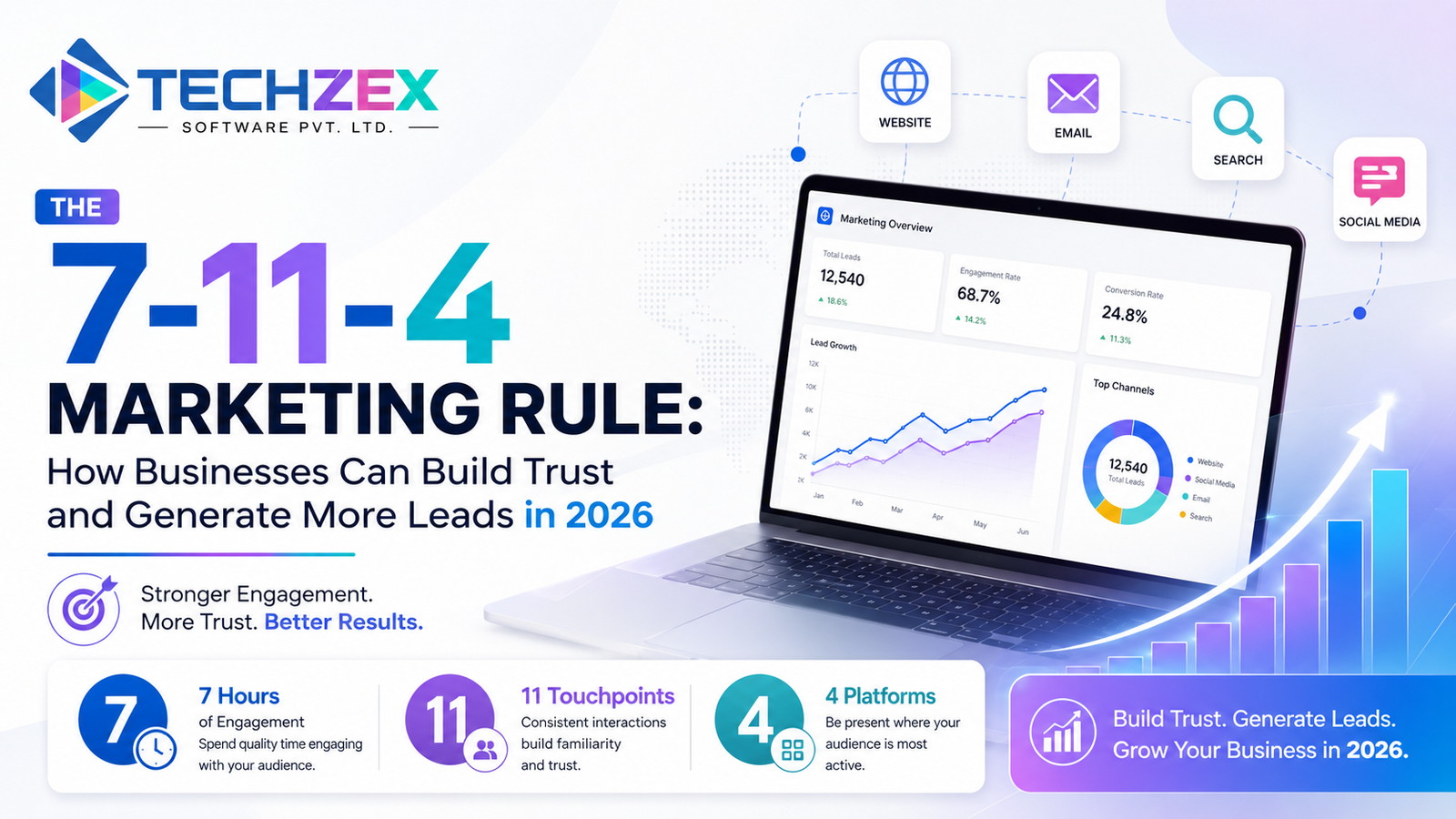
This is the main idea behind the 7-11-4 marketing rule a popular framework used to explain how repeated content engagement and multichannel visibility can influence a customer’s purchasing decision.
According to the framework, a potential customer may need approximately:
- 7 hours of cumulative content engagement
- 11 separate customer touchpoints
- 4 different platforms or communication environments
These numbers should not be treated as compulsory targets for every customer. A low-cost product may require fewer interactions, while custom software, website development, business automation or a long-term marketing contract may require considerably more trust.
The real message is simple: customers need enough time, information and repeated exposure before they feel confident choosing your business.
What Is the 7-11-4 Marketing Rule?
The 7-11-4 rule is a customer-journey framework that encourages businesses to build familiarity through useful content and consistent communication.
Instead of expecting one advertisement to produce an immediate sale, the framework asks businesses to create an entire marketing ecosystem.
A customer might first discover your brand through a Google search. They may then read a blog, visit your Instagram page, watch a reel, check your portfolio, read a case study and finally contact your sales team.
These are not separate marketing activities. Together, they form the customer’s decision-making journey.
Google’s ZMOT research similarly highlighted the importance of the research stage that takes place before a customer chooses a product or service. During this stage, people may rely on search results, reviews, videos, social media and official brand websites to evaluate their options.
Understanding the “7 Hours” of Engagement
Seven hours does not mean that a customer must sit on your website continuously for seven hours.
It refers to the combined time a person spends consuming and interacting with your brand’s content over several days, weeks or months.
This engagement could include:
- Reading blog articles and service pages
- Watching educational or product demonstration videos
- Viewing social media reels and posts
- Attending a webinar or online consultation
- Reading case studies and customer success stories
- Exploring product features and pricing
- Reviewing proposals or downloadable guides
- Communicating with your team through email or WhatsApp
For example, someone searching for custom CRM software may spend ten minutes reading a blog, fifteen minutes exploring service pages, twenty minutes watching product videos and thirty minutes attending a demonstration.
As these interactions accumulate, the customer becomes more familiar with the company’s knowledge, experience and ability to solve the problem.
How Businesses Can Create More Engagement Time
Businesses should avoid creating content simply to fill social media calendars. Every piece of content should answer a real customer question.
A website-development company could publish content such as:
- How much does a business website cost?
- What features should an e-commerce website include?
- How does website speed affect lead generation?
- Should a business choose custom development or a template?
- How can SEO help a new website attract customers?
A software-development company could cover:
- When should a business replace Excel with custom software?
- What is CRM software and how does it improve follow-ups?
- How can HRMS software automate attendance and payroll?
- What should be included in a business-owner dashboard?
- How does ERP software reduce repetitive manual work?
Useful content increases engagement because people stay longer when the information directly addresses their problems.
Understanding the “11 Touchpoints”
A touchpoint is any meaningful interaction between a customer and your business.
Touchpoints can happen before, during and after a sales enquiry.
A typical customer journey might look like this:
- The customer sees a social media post.
- They search for the company on Google.
- They visit the business website.
- They read a relevant blog article.
- They watch an Instagram or YouTube video.
- They check customer reviews.
- They view a case study.
- They submit an enquiry form.
- They receive an email or WhatsApp response.
- They attend a consultation or product demonstration.
- They receive a customised proposal and follow-up.
By the eleventh interaction, the customer is no longer dealing with a completely unfamiliar company. They have seen the brand’s expertise, communication quality, service offering and previous work.
This is why consistent follow-up is important. Many businesses stop communicating after one message or one sales call. However, the customer may still be researching and comparing available options.
A structured CRM and lead-management system can help businesses record enquiries, schedule follow-ups, manage sales pipelines and monitor customer activity from one dashboard. Techzex offers CRM and lead-management solutions alongside website, marketing and automation services.
Understanding the “4 Platforms”
The four platforms represent the different places where customers discover and interact with your business.
These could include:
1. Your Website
Your website is the central source of information about your company.
It should clearly communicate:
- What your business offers
- Which industries you serve
- What problems you solve
- How your process works
- Why customers should trust you
- How visitors can contact you
A professional website can contain service pages, product pages, blogs, case studies, testimonials, enquiry forms and downloadable resources.
2. Social Media
Social media allows businesses to remain visible and communicate regularly with potential customers.
Different content formats can serve different purposes:
- Reels capture attention.
- Carousels educate customers.
- Stories provide frequent updates.
- Testimonials build confidence.
- Behind-the-scenes content humanises the brand.
- Promotional posts encourage enquiries.
A business does not need to publish on every available social platform. It should focus on the channels its target customers use most frequently.
3. Search Engines and Online Advertising
Search engine optimisation helps customers discover your content when they actively search for information, products or services.
Google Ads and Meta Ads can increase reach, but advertisements work better when they lead customers to useful landing pages rather than generic homepages.
The landing page should continue the message used in the advertisement and include a clear offer, relevant information, trust signals and a simple lead form.
4. Email, WhatsApp or Direct Communication
Email and WhatsApp help businesses continue the conversation after a customer submits an enquiry.
These channels can be used to send:
- Service information
- Product demonstrations
- Case studies
- Meeting confirmations
- Proposals
- Follow-up reminders
- New offers
- Educational content
Direct communication should provide value rather than sending repeated sales messages without context.
Why One Social Media Post Is Usually Not Enough
Many businesses publish a few posts, run an advertisement for several days and expect immediate sales.
When enquiries do not arrive quickly, they assume digital marketing does not work.
The actual problem may be that the customer has not received enough information to trust the business.
One post can create awareness, but it may not answer questions about pricing, experience, delivery time, service quality, support or previous results.
Similarly, one website visit does not always produce a conversion. The visitor may return later through a Google search, social media post, retargeting advertisement or follow-up email.
Successful marketing connects these interactions instead of treating each platform separately.
How to Apply the 7-11-4 Rule to Your Business
Step 1: Understand Your Customer’s Questions
Start by identifying the questions customers ask before purchasing.
For a website-development service, customers may ask:
- How much will the website cost?
- How long will development take?
- Will it be mobile-friendly?
- Will SEO be included?
- Can the website generate leads?
- Who will provide post-launch support?
For business software, customers may ask:
- Can the software match our current workflow?
- Will our employees be able to use it?
- Can it generate real-time reports?
- Is our business data secure?
- Can new modules be added later?
- What support is available after deployment?
Each question can become a blog, video, FAQ, carousel, case study or sales resource.
Step 2: Build a Strong Website Foundation
Your website should act as the main destination for all marketing activities.
A strong website needs:
- Fast-loading pages
- Mobile-responsive design
- Clear service descriptions
- SEO-friendly content
- Lead-generation forms
- Strong calls to action
- Testimonials and case studies
- Proper analytics and conversion tracking
Techzex develops business websites, e-commerce platforms and landing pages designed around SEO and lead generation. The company also provides social media handling, SEO, Google Ads and Meta Ads, making it possible to connect website development with ongoing marketing.
Step 3: Create a Content Ecosystem
Do not create isolated posts without a larger strategy.
Choose one important customer problem and turn it into several content formats.
For example, a detailed blog titled “How CRM Software Helps Businesses Convert More Leads” can be repurposed into:
- One long-form blog
- One YouTube video
- Three short reels
- One LinkedIn article
- Two Instagram carousels
- One email newsletter
- One downloadable checklist
- Several story updates
This approach helps businesses create more engagement hours without producing completely new ideas every day.
Step 4: Connect Organic and Paid Marketing
Organic marketing builds long-term authority, while paid advertising helps businesses reach targeted audiences faster.
A customer may first see a Meta advertisement, visit the website and leave without enquiring. Later, they may discover an SEO blog, see a testimonial reel and return through a retargeting campaign.
The combined experience can be more effective than depending on only one advertisement.
Step 5: Use Case Studies and Testimonials
Potential customers want evidence that your company can deliver the promised result.
Case studies should explain:
- The customer’s original problem
- The solution provided
- The development or marketing process
- The measurable improvement
- The client’s experience
Techzex presents website, software and digital-marketing services alongside client case studies and business solutions such as HRMS, CRM, billing, fleet management, dashboards and custom ERP systems.
Step 6: Track Every Lead and Follow-Up
Customer touchpoints should not remain scattered across personal WhatsApp accounts, notebooks and Excel sheets.
A lead-management process should track:
- Lead source
- Customer requirement
- Previous interactions
- Proposal status
- Next follow-up date
- Assigned salesperson
- Lead stage
- Reason for conversion or loss
This information helps businesses identify which marketing channels and content types contribute to sales.
Step 7: Measure Results and Improve
The purpose of the 7-11-4 framework is not to count every minute mechanically.
Instead, monitor whether customers are receiving enough useful information across their journey.
Important performance indicators include:
- Website traffic
- Search rankings
- Landing-page conversion rate
- Video watch time
- Social media engagement
- Email open and click rates
- Enquiry volume
- Cost per lead
- Follow-up completion
- Lead-to-customer conversion rate
- Average sales cycle
These insights can reveal where the customer journey becomes weak.
For example, strong website traffic with few enquiries may indicate an unclear offer or weak call to action. High lead volume with poor conversions may indicate insufficient follow-up, incorrect targeting or a lack of trust-building content.
A Practical 7-11-4 Content Plan
A small or medium-sized business can begin with the following structure:
| Content Type | Suggested Purpose |
|---|---|
| 4 detailed blogs | Educate customers and support SEO |
| 8–12 short videos | Build awareness and familiarity |
| 8 social media creatives | Explain services, benefits and problems |
| 2 case studies | Demonstrate experience and results |
| 1 downloadable guide | Capture leads |
| 4 email follow-ups | Nurture interested prospects |
| 1 webinar or demonstration | Provide deeper engagement |
| Customer testimonials | Strengthen social proof |
| Retargeting advertisements | Reconnect with previous visitors |
The exact number should be adjusted according to the business, target audience, sales cycle and available budget.
Quality and relevance are more important than publishing large amounts of repetitive content.
Common Mistakes to Avoid
Selling Too Early
Not every customer is ready to purchase after the first interaction. Begin by solving a problem or answering a question before asking for a sale.
Depending on Only One Platform
A business that depends entirely on Instagram, Facebook or paid advertisements becomes vulnerable to changing algorithms and increasing advertising costs.
Build owned marketing assets such as a professional website, blog, email list and customer database.
Publishing Without a Clear Strategy
Every post should support a business objective such as awareness, education, engagement, trust building, lead generation or conversion.
Ignoring Follow-Ups
A qualified lead can be lost when the business does not respond quickly or fails to schedule the next interaction.
Using Different Messages Everywhere
Your visual identity, value proposition, tone and service information should remain consistent across your website, advertisements, social media and sales communication.
Is the 7-11-4 Rule Suitable for Every Business?
The principle is useful for most businesses, but the exact numbers will vary.
An inexpensive, frequently purchased product may require fewer interactions. A high-value service such as custom software, ERP development, website development, digital-marketing retainers, property, education or consulting may require a longer decision-making process.
Therefore, businesses should use 7-11-4 as a planning guide:
- Create enough valuable content.
- Build repeated customer interactions.
- Maintain visibility across relevant platforms.
- Track leads and follow-ups.
- Make it easy for customers to verify your credibility.
- Provide clear opportunities to contact your business.
Build a Connected Digital Marketing Ecosystem with Techzex
Modern customers do not experience your website, social media, advertisements and sales follow-ups separately. Together, these interactions shape how they perceive your brand.
Techzex Software helps businesses create a connected growth ecosystem through:
- Website design and development
- E-commerce website development
- Social media handling
- Search engine optimisation
- Google Ads and Meta Ads
- CRM and lead-management software
- Business dashboards
- Custom ERP and automation solutions
- Mobile application development
Techzex’s website positions the company as a single partner for websites, marketing, software and business automation, serving businesses in India and international markets.
Conclusion
The 7-11-4 marketing rule reminds businesses that trust is rarely created through one advertisement, one social media post or one sales call.
Customers need useful information, repeated interactions and a consistent brand experience before they feel comfortable making a decision.
Your exact target may not always be seven hours, 11 touchpoints and four platforms. However, the underlying strategy remains valuable:
Educate consistently, appear across relevant channels, follow up professionally and make every interaction useful.
When your website, content, SEO, social media, advertisements and lead-management process work together, marketing becomes more than occasional promotion. It becomes a structured system for building trust and generating sustainable business growth.
Frequently Asked Questions
What is the 7-11-4 marketing rule?
The 7-11-4 rule is a marketing framework suggesting that customers may need several hours of content engagement, multiple brand interactions and exposure across different platforms before they feel ready to purchase.
Is the 7-11-4 rule officially created by Google?
The framework is commonly attributed to Google online, but a primary Google source confirming the exact seven-hour, 11-touchpoint and four-platform formula is difficult to verify. Google’s official ZMOT research does support the broader idea that customers research brands through multiple digital sources before purchasing.
What is a customer touchpoint?
A customer touchpoint is any interaction a person has with a business, including advertisements, website visits, social media posts, emails, phone calls, reviews, demonstrations and sales follow-ups.
How can small businesses apply the 7-11-4 rule?
Small businesses can begin with a professional website, SEO blogs, social media videos, customer testimonials, email or WhatsApp follow-ups and a CRM system for managing enquiries.
Which four marketing platforms should a business use?
The right platforms depend on the target audience. A practical combination could include the company website, Google Search, social media and email or WhatsApp communication.
How does the 7-11-4 rule improve lead generation?
It encourages businesses to educate customers, increase brand visibility, provide multiple trust signals and maintain consistent follow-ups throughout the customer journey.