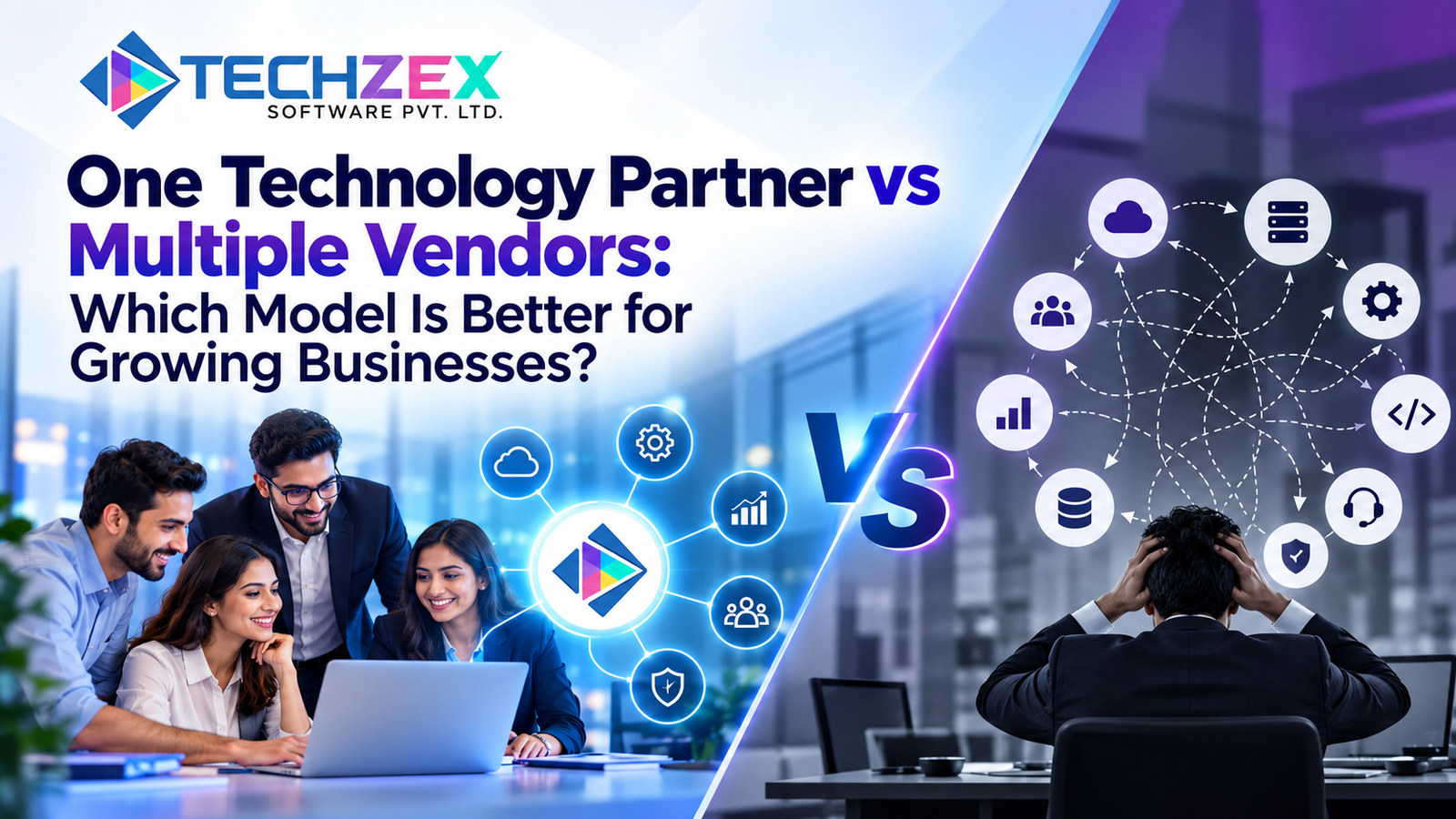
As a business grows, its technology requirements become more complex.
A company may initially need only a professional website. A few months later, it may require SEO services, social media marketing, Google Ads, Meta Ads, CRM software, HRMS, mobile applications, custom dashboards, ERP software, e-commerce development, or business automation solutions.
At this stage, one important question arises:
Should the company work with multiple specialized vendors or choose one technology partner that can manage most of its digital and software requirements?
Both approaches have advantages. However, for many growing businesses, managing different agencies and software vendors can eventually create communication gaps, integration problems, duplicated work and unclear accountability.
In this article, we compare the one technology partner vs multiple vendors models to help businesses understand which approach may suit their growth plans.
What Is the Multiple-Vendor Model?
In a multiple-vendor model, a business works with different companies or freelancers for different requirements.
For example:
One agency handles website development
Another agency manages SEO
A different company handles social media marketing
Another team manages Google Ads and Meta Ads
A software company develops the CRM
Another provider supplies HRMS
A freelancer develops the mobile app
Another vendor manages the server or technical support
This approach can work well when a business needs highly specialized expertise for individual projects.
However, as the number of vendors increases, managing them can become a separate operational responsibility.
What Is the One Technology Partner Model?
A technology partner for business provides multiple technology and digital services through one organization.
Instead of coordinating with several independent companies, the business works with one team for areas such as:
Website design and development
E-commerce website development
SEO services
Social media marketing
Google Ads and Meta Ads
Mobile app development
Custom software development
HRMS
CRM and lead management
ERP solutions
Fleet management software
Billing and inventory systems
Custom dashboards
API integrations
Business process automation
Software maintenance and AMC
The objective is not simply to purchase several services from the same company.
The bigger advantage is creating a connected technology ecosystem where the website, marketing, software, customer data and internal operations can work together.
One Technology Partner vs Multiple Vendors
Let us compare the two models across the areas that matter most to a growing business.
1. Communication and Coordination
With multiple vendors, communication can quickly become complicated.
Imagine that your company is running a Meta Ads campaign that sends enquiries to your website. Those leads then need to enter your CRM automatically.
Three different teams may be involved:
Digital Marketing Agency → Website Developer → CRM Vendor
If something stops working, each vendor may need to investigate whether the issue is on their side.
This increases communication time.
With one technology partner, the same team can understand the complete journey:
Advertisement → Landing Page → Lead Form → CRM → Sales Team → Follow-up → Reporting
When systems are developed and maintained by connected teams, troubleshooting and improvements can become simpler.
2. Website and Marketing Can Work Together
A professional website should not operate separately from digital marketing.
Your website development strategy, SEO strategy, Google Ads campaigns, Meta Ads campaigns and lead generation strategy should support each other.
For example, an SEO team may identify an important commercial keyword.
The website team may then need to:
Create a new service page
Improve page speed
Modify headings
Add schema markup
Create lead forms
Improve mobile responsiveness
Add internal links
Optimize conversion elements
If your SEO agency and website development company are completely separate, every small change requires coordination between two organizations.
An integrated technology partner can align website development and digital marketing services from the beginning.
3. Better Integration Between Website and Business Software
Modern websites are increasingly connected to business operations.
A website may need integration with:
CRM software
WhatsApp
Payment gateways
Inventory systems
HRMS
ERP
Billing software
Lead management systems
Mobile applications
Customer dashboards
Analytics platforms
Third-party APIs
Suppose a potential customer fills out a website enquiry form.
Instead of simply sending an email notification, an integrated system could:
Capture the enquiry.
Create a lead in the CRM.
Assign it to a salesperson.
Schedule a follow-up.
Send a notification.
Track the lead through the sales pipeline.
Display conversion data on a management dashboard.
This is where custom software development and business automation become much more valuable than isolated tools.
4. Clearer Accountability
One common problem with multiple technology vendors is determining who owns a problem.
Consider a slow landing page.
The marketing agency may say the website needs optimization.
The website developer may say advertising scripts are slowing the page.
The hosting company may suggest upgrading the server.
The analytics provider may point toward another integration.
Meanwhile, the business owner simply wants the landing page to work properly.
Working with fewer technology partners can simplify accountability because responsibility for the overall solution becomes clearer.
5. Easier Business Automation
Many growing companies still manage important business processes through:
Excel sheets
WhatsApp groups
Paper registers
Manual reports
Separate billing tools
Individual employee spreadsheets
These systems may work when a company is small.
But as the number of employees, customers, branches, leads or transactions increases, manual processes become difficult to manage.
A technology partner that understands multiple departments can identify opportunities for business process automation.
For example:
Lead Generation → CRM → Quotation → Follow-up → Conversion → Billing → Dashboard
or
Employee Attendance → Leave → Payroll → HR Reports
or
Vehicle → Driver → Trip → Fuel → POD → Settlement → Client Billing
Instead of solving every problem with a separate application, the company can gradually build a connected system.
Technology Requirements Change as Businesses Grow
A major reason to consider a long-term technology partner is that today's requirement may not be tomorrow's requirement.
A growing company might follow a journey like this:
Stage 1: Build an Online Presence
The business initially needs:
Business website
Landing pages
Google Business Profile
Basic SEO
Stage 2: Generate More Leads
The next requirements could include:
SEO services
Social media marketing
Google Ads
Meta Ads
Conversion-focused landing pages
Lead generation campaigns
Stage 3: Manage Increasing Leads
As enquiries increase, the company may require:
CRM software
Lead management
Automated lead assignment
Follow-up reminders
Sales reports
WhatsApp integration
Stage 4: Manage Employees and Operations
Growing teams may then need:
HRMS software
Attendance management
Leave management
Payroll
Task management
Project management
Employee dashboards
Stage 5: Automate the Business
Eventually the company may require:
Custom ERP
Billing and inventory software
Fleet management
Asset management
Custom dashboards
Mobile applications
API integrations
Branch management
Business automation
With multiple unrelated vendors, every stage can introduce another system.
With a scalable technology partner, new modules can be planned around the company's existing digital infrastructure.
Cost: Is One Technology Partner Always Cheaper?
Not necessarily.
Choosing the cheapest vendor for every individual service can sometimes reduce the initial project cost.
However, businesses should consider the total cost of technology management, not only development quotations.
Multiple vendors can create indirect costs through:
Repeated meetings
Project coordination
Integration work
Duplicate subscriptions
Separate support contracts
Data migration
Rebuilding incompatible systems
Delayed troubleshooting
Repeated onboarding
A higher initial investment in a well-integrated system can sometimes reduce operational complexity over the long term.
The correct comparison should therefore be:
Project Cost + Integration Cost + Management Time + Maintenance Cost + Future Scalability
rather than simply comparing individual quotations.
When Multiple Vendors Can Be the Better Choice
A single technology partner is not automatically the right solution for every company.
Multiple vendors can make sense when your organization requires highly specialized expertise.
For example, an enterprise might use:
A specialized cybersecurity company
An enterprise cloud infrastructure provider
A dedicated branding agency
A specialized ERP implementation firm
A niche industry software provider
Large companies may also have internal IT teams capable of managing and integrating multiple providers.
The multiple-vendor model can therefore work effectively when the organization has strong internal technical leadership and clearly defined responsibilities.
Challenges of Managing Multiple Technology Vendors
Growing businesses should consider several common challenges before increasing the number of vendors they work with.
Different Technology Stacks
One developer may use PHP and Laravel.
Another may use Node.js.
Another vendor may build the mobile application using a completely different architecture.
Different technologies are not necessarily a problem, but without proper planning they can increase maintenance and integration complexity.
Separate Databases
The website may contain customer information.
The CRM may contain another version.
Billing software may maintain separate customer records.
The result can be duplicate and inconsistent data.
Multiple Support Teams
When something breaks, identifying the responsible vendor becomes difficult.
Different Priorities
Your website agency may prioritize design.
Your marketing agency may prioritize conversion.
Your software company may prioritize functionality.
A unified technology strategy should balance all three.
Poor Scalability
Systems built independently may become difficult to connect later.
This is particularly important for businesses planning to implement CRM, HRMS, ERP, mobile apps, dashboards and business automation over time.
Benefits of Having One Long-Term Technology Partner
For many small and medium-sized businesses, one capable technology partner can provide several practical advantages.
1. One Team Understands Your Business
The longer a technology team works with your organization, the better it understands:
Your customers
Internal processes
Employees
Sales workflow
Marketing strategy
Software requirements
Reporting requirements
Future expansion plans
This context can make future development faster and more relevant.
2. Better Technology Planning
Instead of solving requirements individually, the team can consider how today's decision will affect tomorrow's system.
For example, a website database structure can be designed with future CRM integration in mind.
3. Consistent User Experience
Your website, customer portal, mobile application and admin dashboard can follow similar branding and workflows.
4. Faster Integration
When teams already understand the existing architecture, adding new modules and integrations can become easier.
5. Long-Term Support
Technology does not end when a website or application launches.
Businesses require:
Bug fixes
Security updates
Feature additions
Software upgrades
Server maintenance
SEO improvements
New landing pages
API changes
Performance optimization
This makes AMC and long-term technology support an important part of business technology planning.
Why Business Software Should Not Be Treated as Separate Tools
Businesses often purchase software whenever a new problem appears.
They may buy one tool for attendance, another for CRM, another for billing, another for projects and another for reporting.
Soon, employees are switching between several applications.
A better long-term approach is to think in terms of a connected business software ecosystem.
For example:
HRMS
An HRMS can manage:
Employee attendance
Leave
Payroll
Shifts
Employee records
CRM
CRM software can manage:
Leads
Follow-ups
Sales pipelines
Customer communication
Sales reports
ERP
A custom ERP can connect several operational areas within one system.
Custom Dashboard
A real-time business dashboard can provide management with important KPIs related to:
Sales
HR
Finance
Inventory
Marketing
Fleet operations
Branch performance
Instead of opening five reports, business owners can get important information from one dashboard.
The Role of Custom Software Development
Ready-made software is useful when your process is standard.
But every growing business eventually develops unique workflows.
That is where custom software development becomes valuable.
A custom software development company can build solutions around existing business processes instead of forcing the organization to completely change how it operates.
Custom solutions may include:
Custom CRM
Custom ERP
Lead management system
Inventory management
Billing software
Fleet management software
Franchise management
Project management
Asset management
Owner dashboard
Customer portal
Mobile application
Workflow automation
The goal should not be custom development for everything.
The goal should be choosing between ready-made and custom software based on what gives the business the best combination of cost, efficiency and scalability.
What Should You Look for in a Technology Partner?
Before selecting a long-term IT services company, evaluate more than its portfolio.
Look for a partner that can understand both technology and business operations.
Important areas include:
Website Development Expertise
The company should understand responsive design, SEO-friendly development, performance, security and conversion-focused website architecture.
Digital Marketing Capability
Your technology partner should understand how SEO, content marketing, social media, Google Ads and Meta Ads connect with the website.
Custom Software Development
The team should be capable of developing business-specific software when ready-made products are insufficient.
API and Integration Expertise
Modern software rarely works independently. Integration capability is essential.
Business Automation Experience
A good technology team should identify manual processes that can be automated.
Mobile App Development
Businesses increasingly require Android and iOS applications for customers, employees, field teams and management.
Long-Term Support
Ask what happens after deployment.
Development without maintenance planning can create long-term problems.
Scalability
The technology architecture should support future users, branches, transactions, modules and integrations.
Which Model Is Better for a Growing Business?
There is no universal answer.
Businesses that need highly specialized independent expertise and have strong internal IT management may benefit from multiple vendors.
However, businesses looking to connect website development, digital marketing, CRM, HRMS, ERP, mobile apps, custom dashboards and business automation may benefit from working with fewer, more integrated technology partners.
For many growing companies, the biggest advantage is not simply convenience.
It is continuity.
Your website team understands your marketing.
Your marketing team understands your CRM.
Your CRM connects with your sales process.
Your software team understands your operations.
And management gets visibility through centralized dashboards and reports.
That creates a stronger digital foundation for future growth.
One Partner for Website, Marketing, Software and Automation
Techzex Software focuses on combining website development, digital marketing and business software solutions under one technology ecosystem, including websites, SEO, social media, advertising, HRMS, CRM, fleet management, dashboards, mobile applications and custom ERP solutions.
Instead of looking at technology as separate projects, growing businesses can plan their digital presence, lead generation, internal software and automation as connected parts of the same business strategy.
If your company currently manages its website, marketing, leads, employees, reporting and operations through different disconnected systems, it may be worth reviewing which processes can be integrated.
Ready to Build, Grow and Automate Your Business?
Whether you need a professional business website, e-commerce website, SEO services, social media marketing, CRM, HRMS, fleet management software, custom ERP, mobile app or custom business dashboard, Techzex Software can help you plan a solution based on your business requirements.
Talk to Techzex Software about your website, software, digital marketing or business automation requirements.
Frequently Asked Questions
1. What is a technology partner for a business?
A technology partner is a company that supports multiple areas of a business's technology strategy, such as website development, digital marketing, software development, CRM, HRMS, ERP, mobile apps, dashboards, integrations and automation.
2. Is it better to use one IT company or multiple vendors?
It depends on the business. Multiple vendors can provide specialized expertise, while one technology partner can simplify coordination, integration and long-term support. Growing businesses should consider their internal technical resources, complexity and future technology requirements.
3. Can one technology company manage website development and digital marketing?
Yes. An integrated provider may manage website development together with SEO, social media marketing, Google Ads, Meta Ads, landing pages and lead generation. This can help align website changes with marketing objectives.
4. Why is business automation important for growing companies?
As a company grows, manual processes involving Excel, WhatsApp, paper records and separate applications can become difficult to manage. Business automation connects workflows, reduces repetitive work and provides better operational visibility.
5. What software does a growing business need?
Requirements differ by industry, but common systems include CRM, HRMS, billing and inventory software, project management, ERP, fleet management, mobile applications and custom dashboards.
6. What is custom software development?
Custom software development involves building software according to a company's specific processes and requirements rather than relying entirely on generic ready-made software.
7. Can CRM, HRMS and ERP be integrated?
Yes. Depending on the software architecture and available APIs, CRM, HRMS, ERP, billing, inventory, websites, mobile applications and dashboards can be connected to create a more centralized business system.
8. Why should a business use a custom dashboard?
A custom dashboard can display important KPIs such as leads, sales, employee information, payments, inventory, fleet activity and operational performance in one place, helping management access key information more efficiently.